
How to Select the Perfect Stone Slab in Person
Why In-Person Selection Matters
Selecting a natural stone slab is less about finding a flawless surface and more about understanding a material in its full physical presence. Marble, quartzite, limestone, granite, onyx, and other natural stones carry qualities that rarely translate completely through a photograph or small sample. Their movement changes across scale. Their color responds to light. Their veining may feel quiet from one distance and dramatic from another.
In a showroom setting, the slab can be read as a whole composition rather than a cropped detail. This is where proportion, rhythm, finish, and application begin to connect. A stone that appears bold in a close-up may become balanced across an island. A subtle material may reveal unexpected depth when viewed upright, under natural light, or beside adjacent finishes.
For designers, architects, builders, and homeowners, in-person slab selection creates a more accurate understanding of what the material will contribute to a space. It allows the decision to move beyond preference and into judgment: how the stone behaves, how it will be fabricated, and how it will sit within the architecture.
Reading Veining, Movement, and Natural Variation
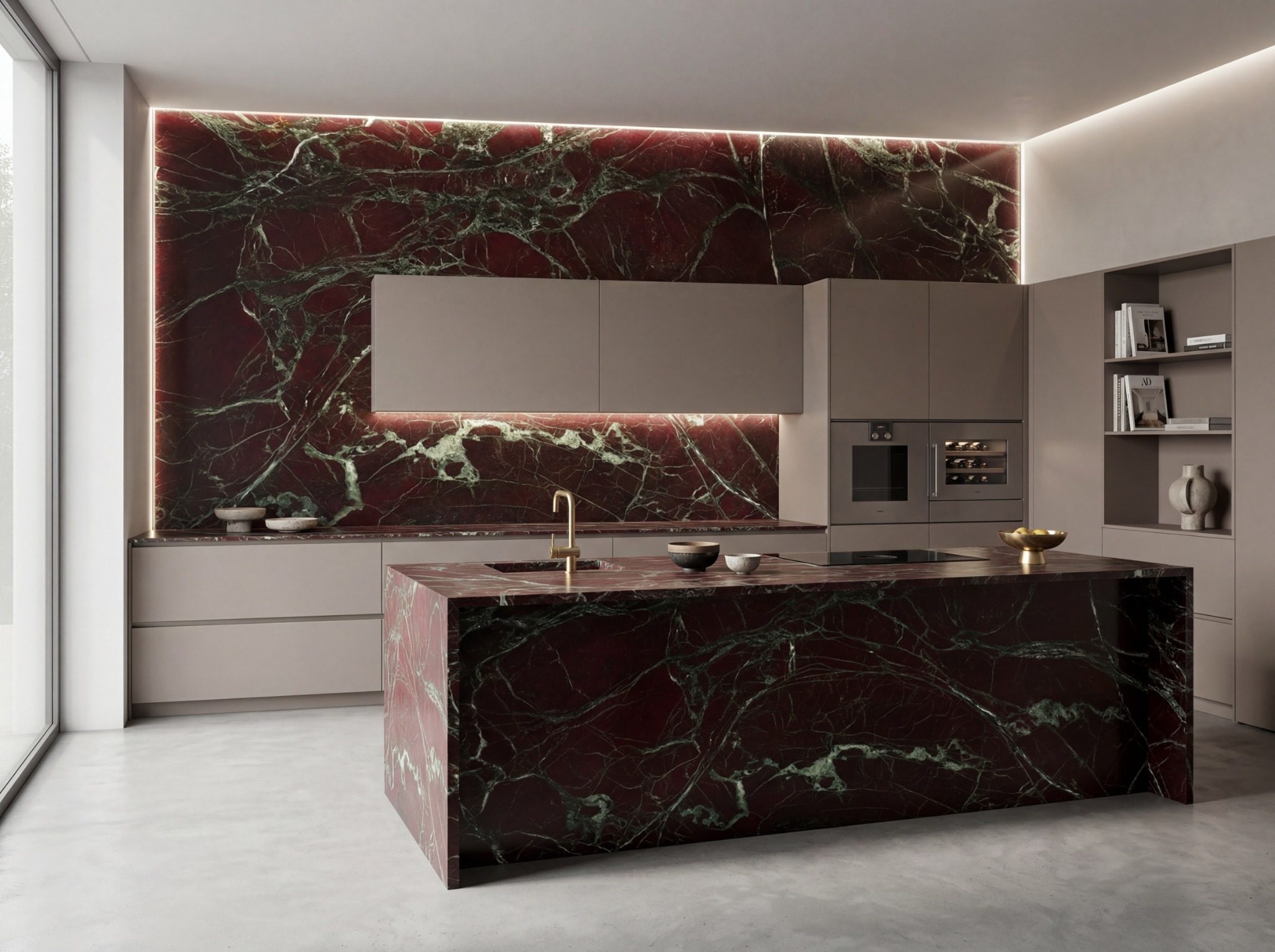
One of the first qualities noticed in a stone slab is movement. Veining, clouding, brecciation, mineral deposits, and tonal shifts all contribute to the surface’s visual character. These qualities are not decorative additions; they are part of the material’s geological formation. In person, they can be evaluated across the entire slab, not just through a selected detail.
A small sample may show color and finish, but it rarely explains scale. It may not reveal whether the veining travels diagonally, pools in one area, opens into negative space, or creates a strong directional flow. Full slabs show whether the material feels calm, expressive, linear, painterly, dense, or open.
Several visual qualities tend to become clearer during in-person selection:
The overall field color, including undertones that may shift warm, cool, creamy, gray, green, gold, or taupe depending on the stone.
The scale of the veining, from fine linear movement to broad architectural gestures that influence layout and fabrication.
The balance between quiet areas and active areas, especially when the slab will be used across large surfaces.
The relationship between finish and depth, since polished, honed, leathered, or brushed surfaces reflect light differently.
The presence of mineral variation, fissures, fossils, crystals, or inclusions that give the slab its specific identity.
Natural variation is not a defect to work around. It is the reason the material has presence. The point of viewing slabs in person is to understand that variation clearly enough to place it with intention.
Understanding Finish, Light, and Surface Behavior
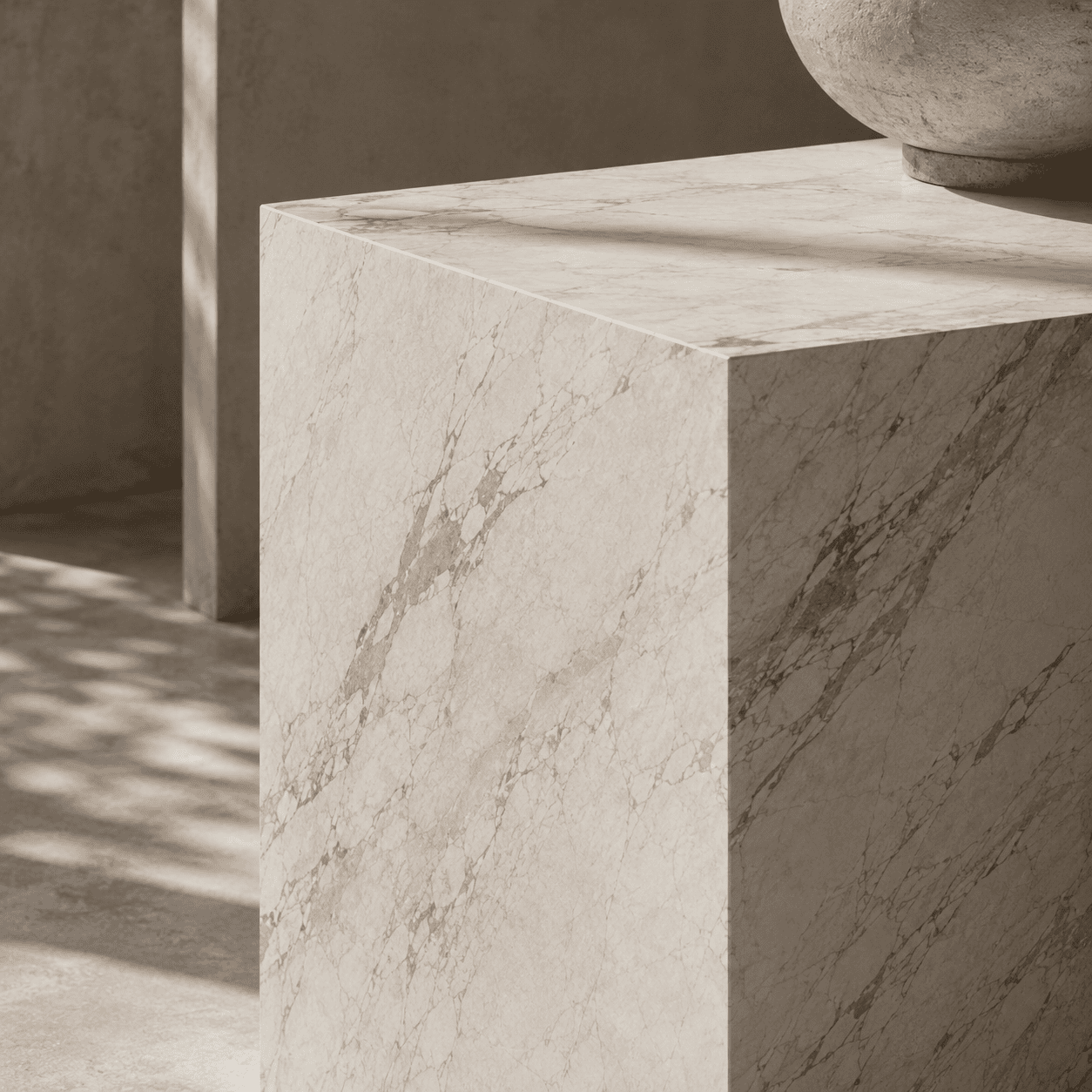
Finish changes the way a stone is perceived as much as color or veining. A polished surface can intensify contrast and create a reflective, formal quality. A honed finish often softens the appearance, reducing glare and giving the material a quieter architectural presence. Textured finishes may emphasize tactility, especially in spaces where the stone is meant to feel grounded rather than ornamental.
Lighting also plays a decisive role. A slab under showroom lighting may appear different near a window, under warm residential lighting, or in a space with cooler architectural illumination. Some stones reveal depth through reflection. Others rely on softness, shadow, and matte texture. Translucent stones such as onyx may change dramatically when backlit, while denser materials such as granite or quartzite often communicate strength through pattern and crystalline structure.
This is why in-person selection is rarely limited to standing directly in front of a slab. The material reads differently from several feet away, from an angle, and in relation to other surfaces. A designer may study the slab as a large plane, then move closer to inspect the finish, edge possibilities, and areas of particular visual interest. That movement between distance and detail is part of the selection process.
Material Performance and Practical Behavior
Natural stone selection also involves understanding how the material performs. Different stones have different densities, porosities, hardness levels, and sensitivities. Marble is often chosen for its depth, softness, and classical movement, while quartzite is recognized for its density and durability. Limestone brings warmth and quiet texture, granite offers strength and crystalline variety, and onyx introduces translucency and dramatic visual depth.
Performance is not a separate conversation from aesthetics. The intended application matters. A kitchen island, fireplace surround, powder room vanity, wall panel, shower, flooring installation, or exterior feature will each place different demands on the material. The same slab may feel appropriate in one setting and less resolved in another, depending on use, scale, exposure, and maintenance expectations.
Sealing, care, and long-term surface behavior are part of professional material understanding. Stone is not chosen because it will remain visually frozen in time. It is chosen with an awareness of how it lives in a space. Some surfaces will develop a patina. Some finishes will show contact differently than others. Some materials require more careful placement. These are not reasons to avoid natural stone; they are reasons to select it with clarity.
A strong slab selection is not only about visual attraction. It is about understanding how a natural material will perform, age, and belong within the architecture.
Connecting the Slab to the Architecture
A slab does not exist independently once installed. It becomes part of a room’s proportions, light, sightlines, and daily use. The same material can feel restrained or dramatic depending on how it is placed. A bookmatched wall may turn veining into a central architectural feature, while a quieter countertop application may allow the stone to support the surrounding design without dominating it.
Scale is central. Large islands, full-height backsplashes, shower walls, and fireplace surrounds allow the slab’s movement to unfold. Smaller applications may call for areas of the stone that feel balanced within tighter dimensions. In some cases, the strongest decision is not the most active portion of the slab, but the area with the right relationship between movement and restraint.
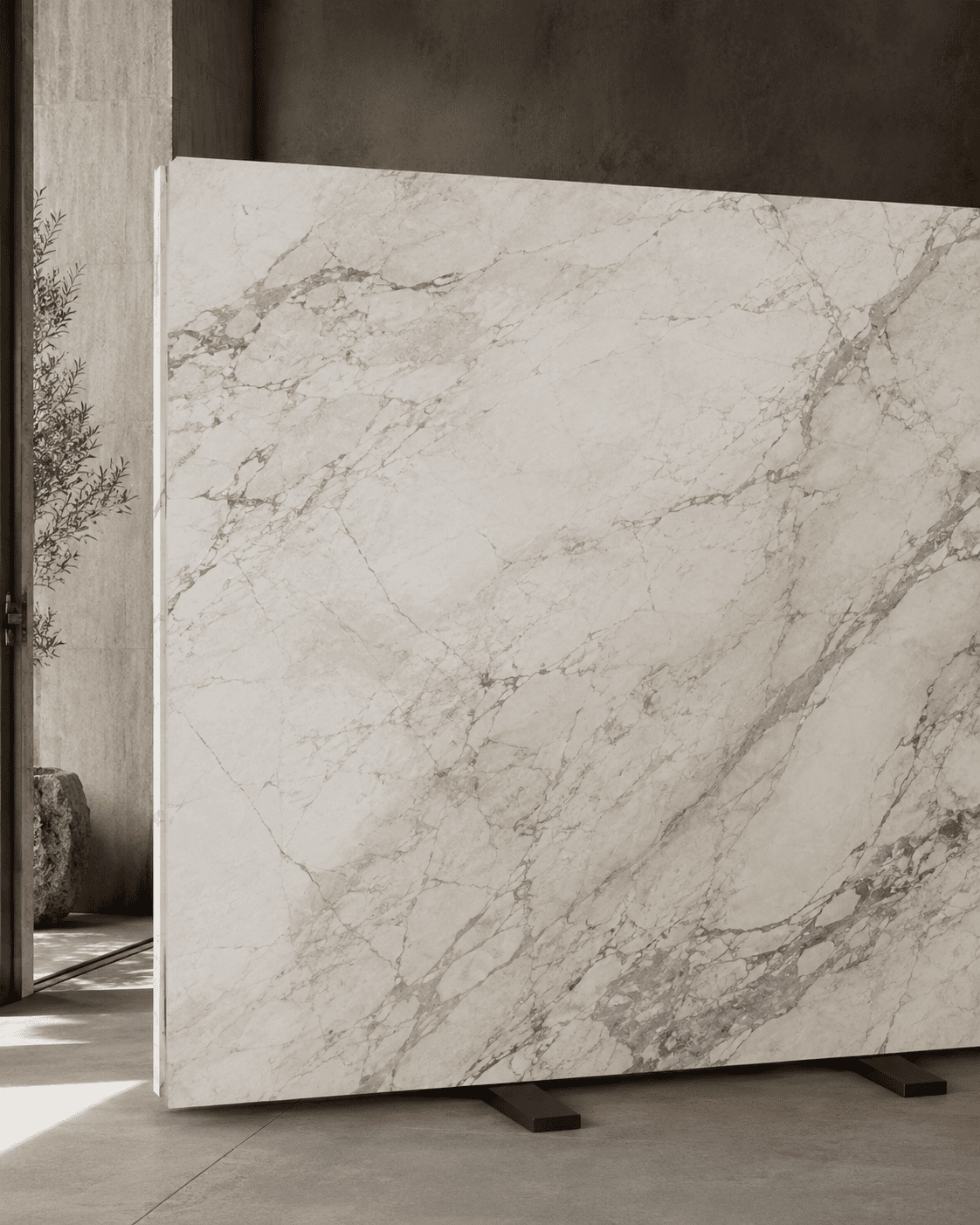
Continuity also matters. Designers often consider how veining will travel across seams, corners, waterfall edges, backsplashes, and adjacent slabs. A beautiful slab can lose coherence if its movement is interrupted without care. Conversely, thoughtful layout can turn natural variation into a quiet architectural rhythm.
Color relationships need the same level of attention. Cabinetry, flooring, metal finishes, plaster, tile, and wall color all affect how the stone reads. A white marble may appear warmer beside cool millwork. A green quartzite may feel more architectural when paired with quiet plaster and dark metal. A limestone may gain depth when set against wood or textured walls. In person, these relationships can be tested with samples and seen at a more honest scale.
Looking Beyond the Small Sample
Small samples are useful, but they are limited. They can confirm general color, finish, and texture, but they cannot fully represent the slab’s composition. Relying on a sample alone can flatten the decision, especially with stones that carry broad movement or irregular veining.
The full slab reveals the material’s character. It shows where the eye naturally travels, where the surface feels calm, and where the pattern becomes more expressive. It also helps clarify whether the stone supports the intended mood of the project. Some interiors need a slab with authority. Others need quietness, softness, or mineral complexity that reveals itself slowly.
This is where experience becomes important. At GEM International, conversations around slab selection often center on how the material will actually be used: the dimensions of the surface, the role of the stone in the room, the surrounding palette, and the expectations for finish and fabrication. The process is less about rushing toward a single “beautiful” slab and more about identifying the right slab for the right architectural condition.
Judgment, Expertise, and the Final Decision
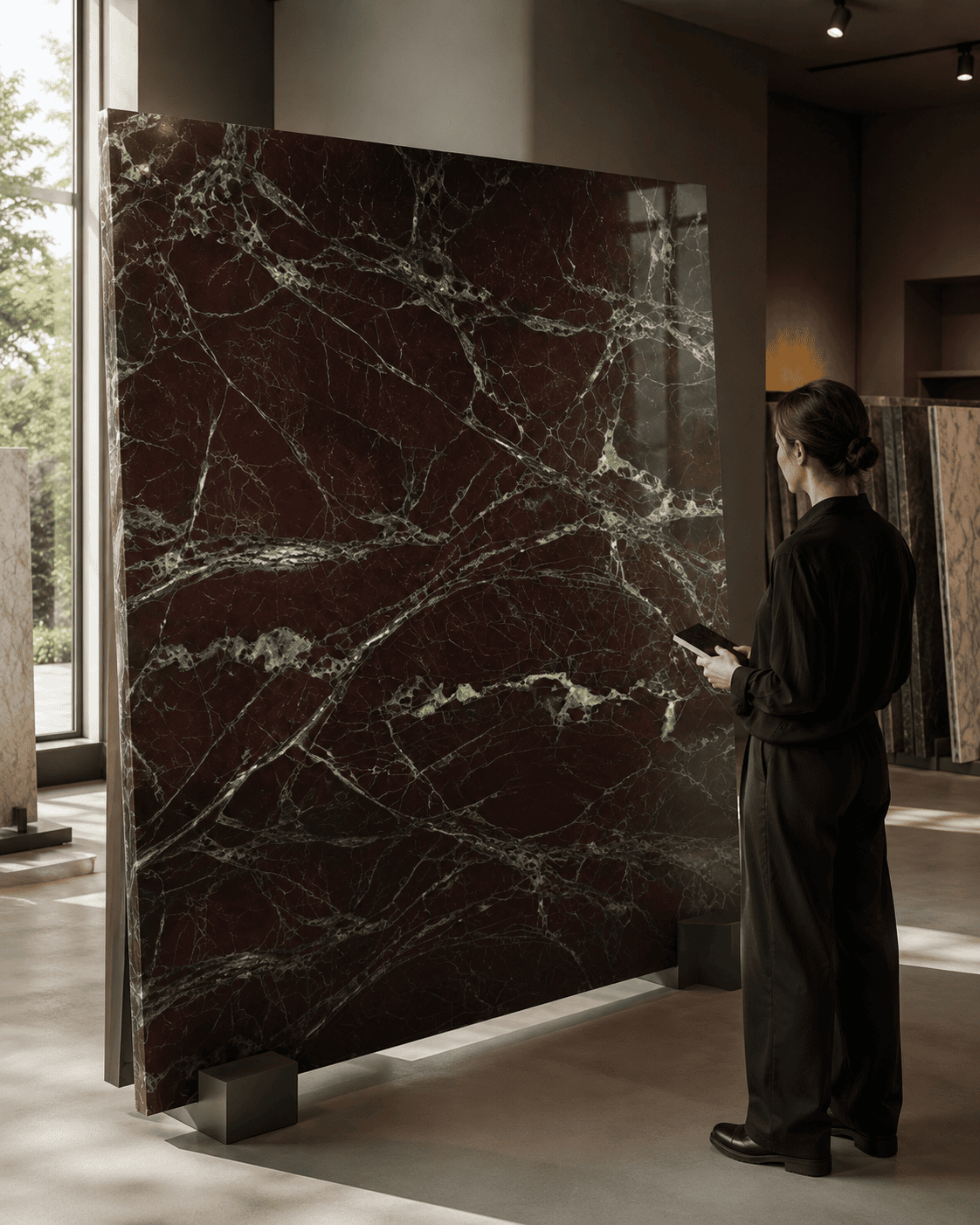
The strongest material decisions usually come from a combination of instinct and informed review. Attraction matters. A slab has to resonate visually. But that first response benefits from being tested against application, scale, lighting, and long-term use.
In-person selection allows questions to become more precise. Does the movement feel balanced across the intended surface? Does the finish support the atmosphere of the room? Will the veining align with the direction of the architecture? Is the slab’s character strong enough, or too strong, for the role it needs to play?
Professionals often make these judgments quickly because they are reading several things at once. They are not only looking at beauty. They are considering fabrication, proportion, adjacency, maintenance, and the emotional tone of the space. A showroom visit gives homeowners and project teams access to that same clarity, especially when supported by people who handle stone every day.
GEM International’s role in that process is quiet but important: making the physical material available to be seen, compared, discussed, and understood at slab scale.
A Considered Choice
Selecting a stone slab in person restores the material to its proper scale. It allows color to be seen in real light, movement to be understood across the full surface, and finish to be evaluated through touch and reflection. It also reveals the qualities that make natural stone difficult to reduce to a photograph: depth, irregularity, mineral presence, and the subtle tension between control and variation.
A considered stone choice does not come from rushing the decision or treating every slab as interchangeable. It comes from looking carefully, asking better questions, and allowing the material to be understood before it is assigned a role.
For projects where stone will define a room, anchor a surface, or become part of the architecture itself, that in-person experience remains essential. The conversation can continue in the GEM International showroom, where slabs can be viewed at full scale and discussed with specialists who understand how natural stone moves from selection to finished space.